
Technology

RIPL™

Resin-Infused Powder Lithography. A 5-micron voxel process that builds net-shape stainless parts — with the surface finish and tolerances of machining, and none of its constraints.
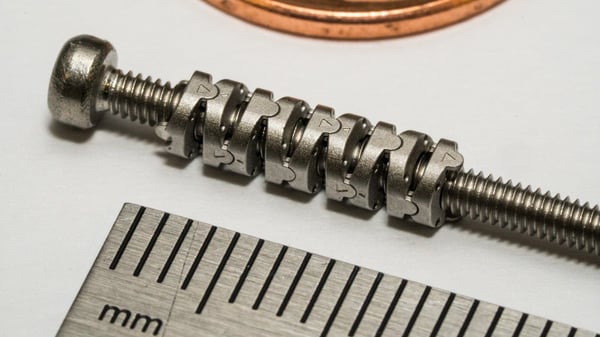
5 µm
VOXEL RESOLUTION
±0.0006″
±1.5% TOLERANCE
Ra 32 µin
NATIVE FINISH
Technology
How it works

From STEP file to sintered metal

Four steps, one process — the same sequence at 10 parts and at 100,000.

Print

Print

Lithographic printing builds a green part in 5 µm voxels from a blend of resin and metal powder.

Green state

Green state

Excess print material is removed. No supports are used in printing; surface finish is consistent, and no defects are introduced by processing after the print.

Sinter

Sinter

Parts are sintered to 97% relative density (ASTM B311), with dimensional control held to ±0.0006″ or ±1.5%.

Finish & verify

Finish & verify

Ra 32 µin native surface. Inspection to your critical tolerances under an ISO 13485 QMS.

What you can design

The envelope, in four numbers.

Everything else — aspect ratios, powder-removal paths, tolerance by feature class — is in the RIPL Design Guide.

25 µm features

minimum feature size, as printed

5 µm resolution

voxel and layer thickness

316L · 17-4PH

available now

±0.0006″ tolerances

typical; scales with part size

Same part, both ways

Machined on top. Printed below. Measure them.

The same multi-lumen tip component, made conventionally and made on RIPL — measured side by side. Feature dimensions land within microns of each other, and the measured surface roughness is comparable to machining.
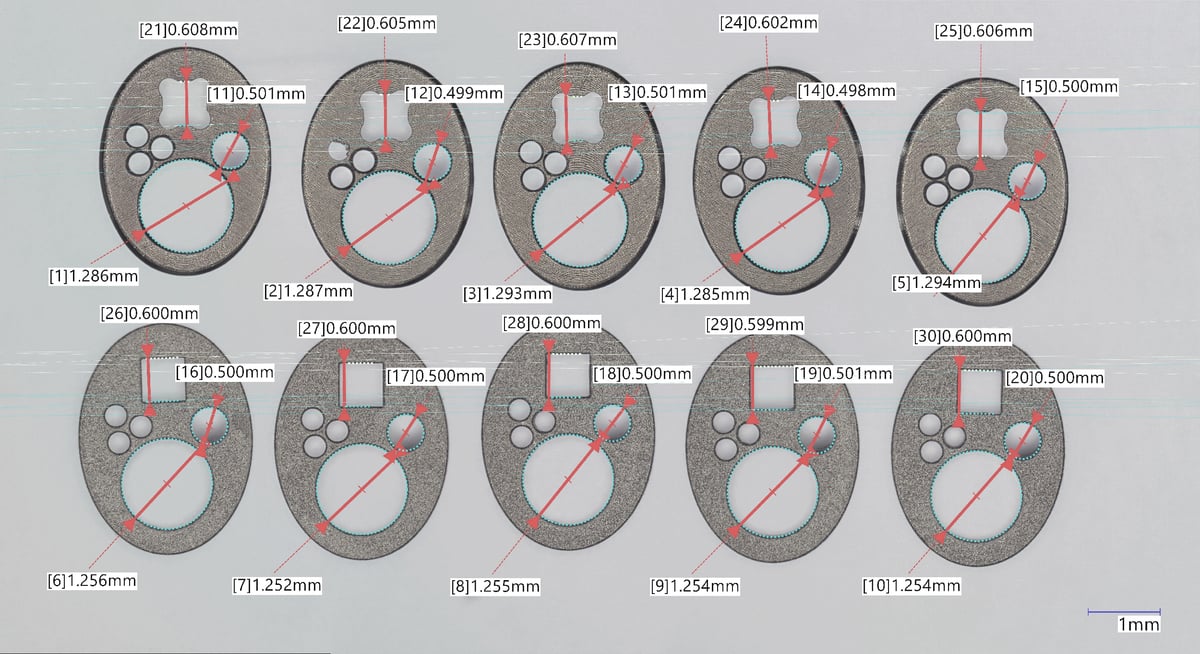
Machined on top. Printed below. Measure them.
HOVER TO ZOOM
Measured on optical CMM · nominal 0.500 mm bores read 0.498–0.501 mm on both rows · 1 mm scale bar
Against the alternatives

Where each process gives out

  RIPL CNC micro-machining MIM Laser Powder-Bed AM
Tolerance ±0.0006″ typical, verified per part Tighter on tool-accessible features Shrink-dependent; corrected in tooling Coarser; post-machining typical
Micro-features 25 µm features Tool-radius limited Tooling limited ~200+ µm practical
Internal geometry Formed in the print — internal features and undercuts Line-of-sight only Mold-release limited Functionality limited by surface finish
Surface finish Ra 32 µin native Ra 16–63 µin Ra 32–63 µin Ra 200–400 µin
Tooling None Fixtures per part $50K+ molds, months None
Burrs / deburring Burr-free as printed Deburr every edge Gate/flash removal Heavy post-processing
Proto → production Same process, 1 to 100,000+ Re-fixture, re-program Retool per revision Rarely production-rated

Not an attack chart — each process wins its own regime. RIPL's regime: metal parts from 2–5 mm with micro-features, from prototype through production, without tooling.

One process, prototype through production

The prototype process IS the production process.

No tooling to amortize, no requalification cliff between 10 parts and 100,000. Quotes in ~24 hours from a STEP file; delivery in 2–4 weeks.

The prototype process is the production process.