
- Applications
- Interventional Device Solutions
The device is the catheter. The bottleneck is the distal assembly.
Thrombectomy components, delivery-system tips, electrodes — the functional metal at the distal end of an interventional device is where programs stall. It's also where RIPL performs best.
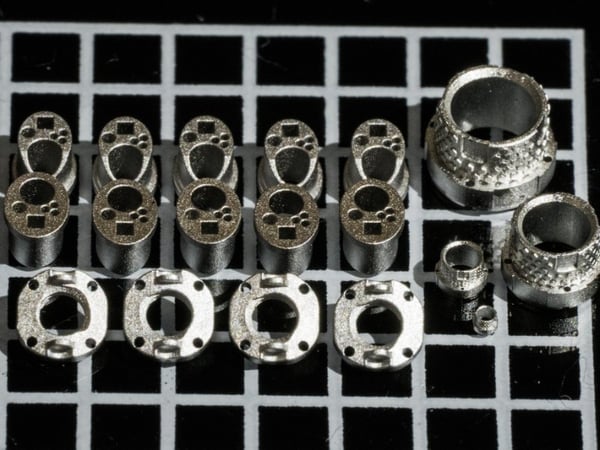
THE CONSTRAINT
Interventional devices keep getting smaller, and the distal assembly absorbs the difficulty. Machined micro-components typically need secondary deburring and edge finishing. Geometry a cutter can't reach becomes several parts plus a joining step. Each extra operation and each extra part adds a supplier, a tolerance, and a failure mode.
WHAT RIPL CHANGES
Single net-shape parts with internal geometry machining can't reach — burr-free as printed, 25 µm features, Ra 32 µin surfaces. The prototype process IS the production process: 1 to 100,000+ without requalification.
THE PROOF
Trio parts are being produced with repeatable quality at production scale for thrombectomy, delivery-system, and catheter-based cardiovascular programs — in 316L and 17-4PH.
What we build for these platforms
| Part class | Why it's hard |
|---|---|
| Electrode components & sub-assemblies | Electrode geometry at endovascular scale, where surfaces and edges are functional and there is little room for post-machining. |
| Guide & catheter tips | Atraumatic external form with functional internal lumens — two geometries in one part machining does in two setups plus joining — plus texturing for reflowing and bonding polymer liners and jackets. |
| Articulating steerable assemblies | Links and steering features for articulating distal sections — geometry that otherwise means laser-cut tube plus secondary joining. |
| Delivery-system components | Sheath tips, capsule features, and structural micro-parts for TAVR/TMVR delivery — deployment systems increasingly depend on complex micro-mechanisms, each one a small part with functional features. |
Design to the problem, not the process.
The RIPL Design Guide covers wall minimums, aspect ratios, powder-removal paths, and material properties — everything your CAD needs before the first quote.
5 µm resolution
voxel and layer thickness
Ra 32 µin
as-built surface finish
±0.0006″ tolerances
typical; scales with part size
~24 h
quote turnaround