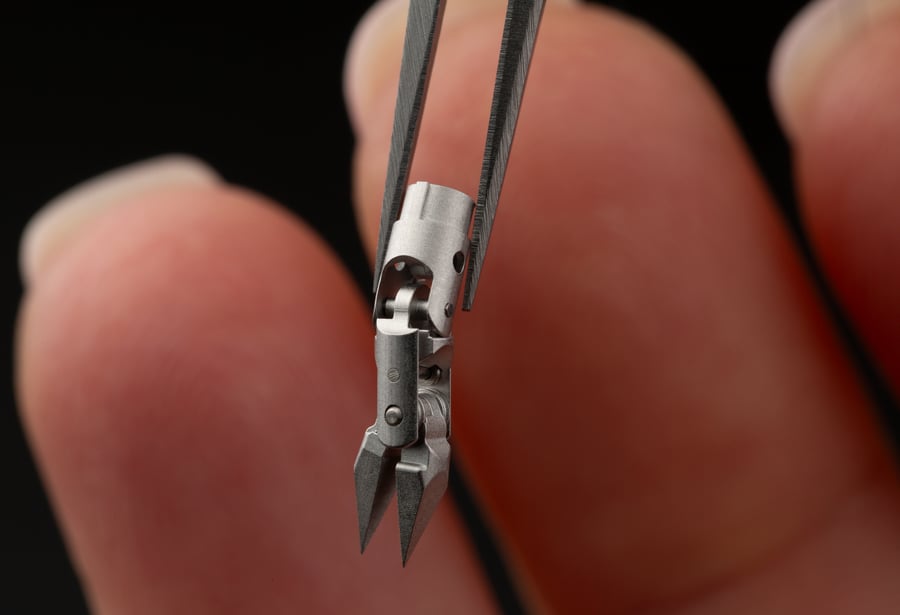
THE CONSTRAINT

A wristed end-effector is a stack of micro-parts — each with tolerance stack-up, each a supplier, each an assembly step. Below ~5 mm, the machining and assembly economics collapse just as clinical demand pushes instruments smaller.

WHAT RIPL CHANGES

Net-shape links and wrist components, each a single part with its tendon paths and mating features formed in the print — no tooling, no burrs, no secondary machining. Design iterations turn in weeks, on the same process that runs production.

THE PROOF

Trio parts are being produced with repeatable quality at production scale for robot-assisted platforms — from robotic bronchoscopy articulation to complete surgical-wrist systems — in 316L and 17-4PH.


Part classes

What we build for these platforms

Part class Why it's hard
Articulating links Serial chains of identical millimeter-scale links, each with tendon channels and mating features.
End-effector tips & jaws Grasping/cutting features with sharp functional edges at millimeter scales; burrs are a clinical hazard and deburring destroys geometry.
Wrist bases & clevises Multiple intersecting bores and tendon passageways in one small body — the classic five-axis nightmare.
Cable terminations & routing features Tendon anchors, guides, and mounting features at the wrist — small, load-bearing, and unforgiving of burrs.
Torque joints & racks Load-bearing micro-features that must hold tolerance under cyclic tendon loads.
Case study · Robot-assisted surgery

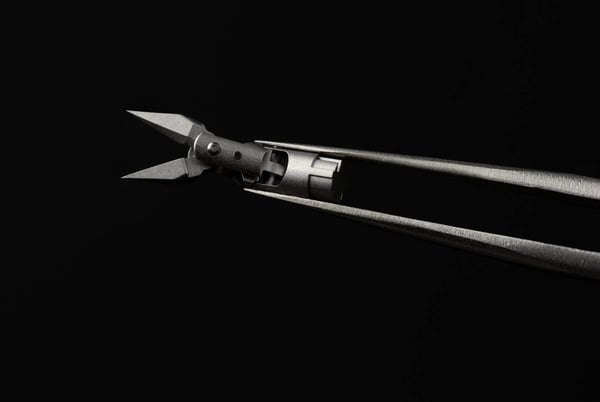
A complete articulated grasper system, from CAD review to parts in hand

A university surgical-robotics lab needed the full distal architecture for a tendon-driven instrument: needle drivers, Maryland graspers, scissors, bending segments, wrist bases, tendon holders — all 316L, all a few millimeters across, all with internal cable paths no machine shop could cut.

Trio's engineers reviewed each part against RIPL design rules and returned feedback in days. A trial order validated the parts; the full system order followed the same month.

Image
Design for RIPL

Design to the problem, not the process.

The RIPL Design Guide covers wall minimums, aspect ratios, powder-removal paths, and material properties — everything your CAD needs before the first quote.

25 µm features

minimum feature size, as printed

2–5 mm

typical part size

316L · 17-4PH

available now

1371 MPa UTS, no HIP

17-4PH H900 · wrought reference 1310 MPa